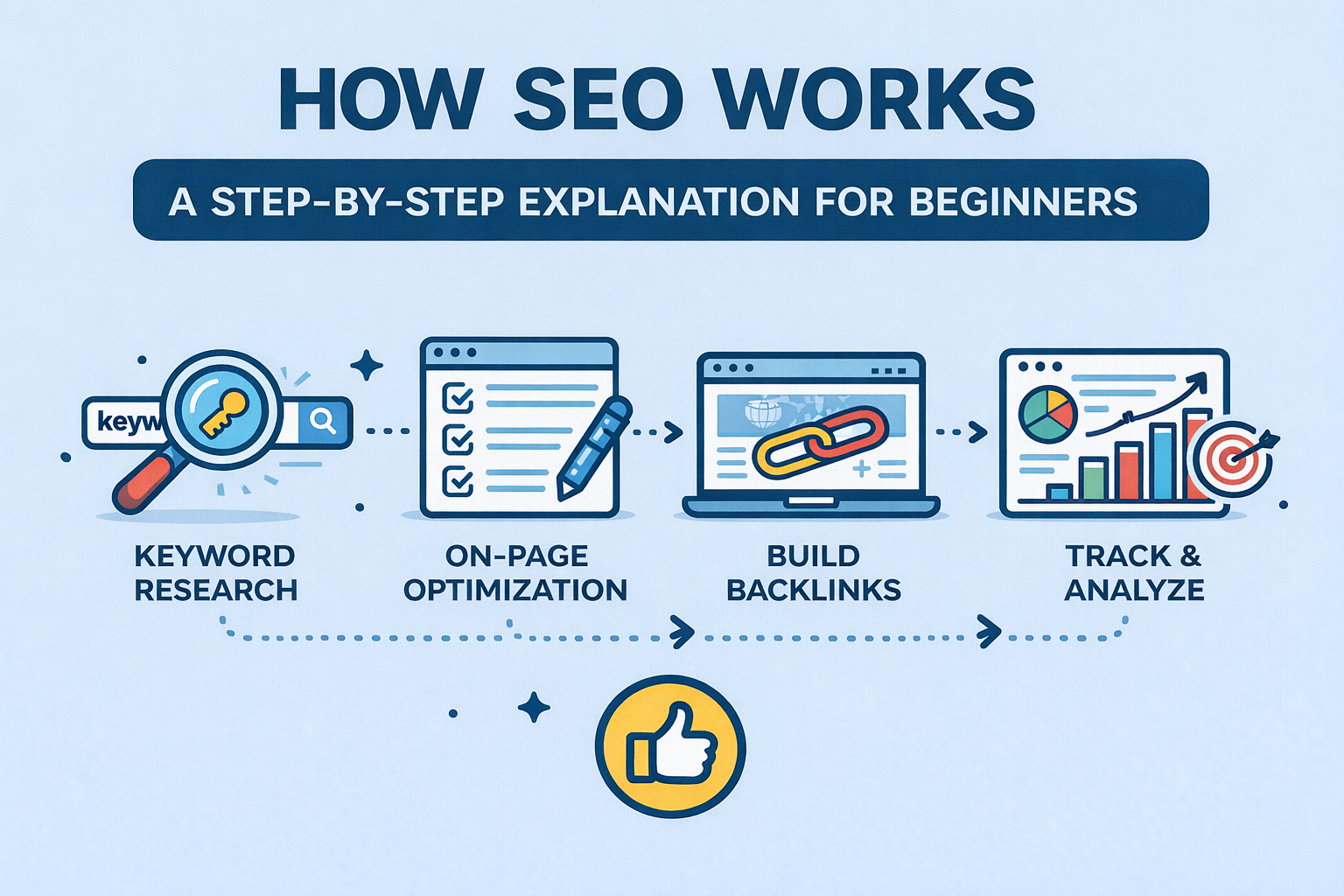
Search engine optimization may sound complex, but how SEO works is actually pretty straightforward once you break it down. This step by step SEO guide is designed for small business owners, bloggers, and marketers who want to understand search engine optimization basics without getting lost in technical terminology.
SEO for beginners starts with understanding how search engines like Google discover, analyse, and rank your website among millions of others. When you grasp these fundamentals, you can make smart decisions that help your ideal customers find you.
We’ll guide you through how search engines crawl websites and how this impacts visibility, break down keyword research for beginners to help you connect with your audience, and explore practical SEO content strategies that deliver results. You’ll also learn which ranking factors matter most and how to use key SEO metrics and analytics to measure success.
By the end, you’ll have a clear roadmap for improving your search rankings and attracting more visitors to your website.
Understanding SEO
Define search engine optimization in simple terms
Search engine optimization (SEO) is the practice of improving your website so it appears higher when people search for topics related to your business on Google, Bing, and other search engines.
Explain how search engines discover and rank websites
Search engines use automated programs called crawlers to scan billions of web pages, following links from one page to another like a digital spider web. These crawlers analyse your content, loading speed, mobile-friendliness, and hundreds of other ranking factors to determine where your site should appear in search results compared to competitors.
Reveal the business impact of appearing in top search results
The top three search results capture over 60% of all clicks, meaning higher rankings directly translate to more website visitors, leads, and sales.
Identify who benefits most from SEO strategies
Local businesses, online retailers, service providers, and content creators benefit enormously from SEO strategies. Companies with limited advertising budgets particularly thrive because SEO delivers long-term results without ongoing ad spend. Even established brands use SEO to maintain market dominance and capture customers at every stage of their buying journey.
How Search Engines Crawl and Index Your Website
Break Down the Crawling Process Step-by-Step
Search engine crawling works like a digital spider exploring the web through interconnected pathways. Search engine crawling begins when bots discover your website through links from other sites or submitted sitemaps. These automated crawlers follow every link they find, jumping from page to page while analysing content, structure, and relevance signals that determine your site’s value.
Explain How Search Engines Store and Organize Web Pages
After crawling, search engines process and store your web pages in massive databases called indexes. This indexing system organizes content by topics, keywords, and quality signals, creating a searchable library that responds instantly when users enter queries. Your pages compete for prime index positions based on relevance, authority, and user experience factors.
Identify Common Crawling Obstacles That Hurt Visibility
Several technical barriers can block search engines from properly crawling your website. Common obstacles include:
- Internal links that are broken, creating dead ends for search engine crawlers
- Slow page loading speeds that cause bots to abandon crawling sessions
- Missing or incorrect robots.txt files that accidentally block important pages
- Duplicate content that confuses crawlers about which version to index
- Poor mobile optimization that affects crawler accessibility on mobile devices
|
Crawling Obstacle |
Impact Level |
Quick Fix |
|
Broken Links |
High |
Regular link audits |
|
Slow Loading |
Critical |
Optimize images/code |
|
Robots.txt Errors |
High |
Review file syntax |
|
Duplicate Content |
Medium |
Add canonical tags |
The Three Pillars of SEO That Drive Rankings
Master on-page optimization for maximum relevance
On-page SEO starts with title tags, meta descriptions, and heading structure. Your content needs strategic keyword placement in titles, headings, and throughout the text without stuffing. Internal linking connects your pages while helping search engines understand your site’s hierarchy and topic relationships.
Build off-page authority through quality backlinks
Search engine optimization basics include earning backlinks from reputable websites in your industry. Quality beats quantity every time – one link from a trusted source outweighs dozens from low-authority sites.
Optimize technical elements for better user experience
Technical SEO focuses on site speed, mobile optimization, and how easily search engines can crawl your website. Search engines favour websites that load quickly and work seamlessly across devices. Clean URL structures, XML sitemaps, and proper schema markup help search engine crawling while improving user navigation and experience.
Balance all three pillars for sustainable results
SEO ranking factors work together like a three-legged stool – removing any pillar weakens the entire structure. Your SEO strategy should include content quality, link building, and technical performance simultaneously. Focusing on just one area while neglecting others limits your potential rankings and long-term success.
Keyword Research That Connects You With Your Audience
Find right keywords your customers actually search
Start your keyword research by thinking like your customers. What problems do they face? What solutions do they search for? Use free tools like Google’s Keyword Planner to discover terms people actually type into search engines. Focus on long-tail keywords—specific phrases like “how to fix leaky faucet” instead of just “plumbing.”
Analyse search volume and competition levels
Balance search volume with competition when choosing keywords. High-volume terms might seem attractive, but they’re often dominated by established websites. Look for the sweet spot: keywords with decent search numbers but manageable competition.
Map keywords to specific pages and content types
|
Content Type |
Keyword Focus |
Example |
|
Blog Posts |
How-to keywords |
“how SEO works” |
|
Product Pages |
Commercial keywords |
“best SEO tools” |
|
Landing Pages |
Problem-solving |
“improve website ranking” |
Each page should target one primary keyword plus 2-3 related terms. Create a content map linking specific keywords to individual pages, ensuring you don’t compete against yourself.
Avoid keyword stuffing while maintaining relevance
Write naturally while incorporating your target keywords. Your primary keyword should appear in the title, first paragraph, and naturally throughout the content. Don’t force keywords into every sentence. Instead, use synonyms and related terms that support your main topic while keeping the content readable and valuable for your audience.
Creating Content That Ranks and Converts Visitors
Write compelling titles and meta descriptions that get clicks
Your title tag acts as your first impression in search results, so make it count. Keep titles between 50-60 characters to avoid truncation, include your target keyword near the beginning. Meta descriptions should expand on your title with 150-160 characters that clearly explain what readers will gain from clicking through.
Structure content with headers that search engines understand
Headers create a logical hierarchy that both readers and search engines can follow easily. Use H1 tags for your main title, H2s for major sections, and H3s for subsections. This structure allows search engines to understand the organization of your content while making it easy for users to quickly scan and navigate to sections of interest.
Incorporate keywords naturally throughout your content
Smart SEO content creation means weaving keywords seamlessly into your writing rather than forcing them awkwardly into sentences. Focus on semantic variations and related terms that support your main keyword while maintaining natural readability. Search engines now prioritize content that genuinely serves user intent over keyword-stuffed articles that feel robotic and unhelpful.
Measuring SEO Success With Essential Metrics
Track rankings for your target keywords
Monitoring where your website ranks for specific keywords gives you a clear picture of your SEO progress. Use tools like Google Search Console, SEMrush, or Ahrefs to track your target keywords weekly. Focus on keywords that matter most to your business goals rather than chasing every possible ranking. Rankings fluctuate naturally, so look for overall trends rather than daily changes.
Monitor organic traffic growth over time
Organic traffic from search engines shows the real impact of your SEO efforts. Google Analytics reveals which pages attract the most visitors and how search traffic changes month over month. Pay attention to both total visitors and the quality of that traffic – more visitors mean nothing if they bounce immediately. Set up monthly reports to spot patterns and seasonal trends.
Analyse click-through rates and user engagement
Click-through rates tell you how compelling your search listings appear to users browsing results. Google Search Console shows your average CTR for different queries and pages. Low CTRs often signal that your titles and descriptions need improvement. Track user engagement metrics like time on page and bounce rate to understand if your content satisfies search intent.
Use data to refine your SEO strategy continuously
SEO success comes from making data-driven decisions rather than guessing what works. Review your metrics monthly to identify which content performs best and which keywords drive the most valuable traffic. Double down on what’s working while adjusting underperforming elements. The most successful websites treat SEO as an ongoing process of testing, measuring, and improving based on real performance data.
Frequently Asked Questions
How does keyword research work in SEO?
Keyword research finding the key words and phrases your target audience types into search engines. You can start by brainstorming topics relevant to your business, then use free tools like Google Keyword Planner to discover search volumes and competition levels. The goal is to identify terms that people actually search for while avoiding overly competitive keywords that are impossible to rank for a new website.
What is on-page SEO and what does it include?
On-page SEO covers all the optimizations you make directly on your website pages. This includes crafting compelling title tags and meta descriptions, using heading tags (H1, H2, H3) to structure content, optimizing images with alt text, and ensuring your URLs are clean and descriptive. Your content should naturally incorporate target keywords while providing genuine value to readers, creating the perfect balance between search engine optimization basics and user experience.
What is off-page SEO and how do backlinks help?
Off-page SEO involves activities outside your website that boost your search engine rankings, with backlinks being the primary focus. When other reputable websites link to your web pages, search engines view this as a vote of confidence and authority.
Conclusion
SEO might seem overwhelming at first, but breaking it down into manageable steps makes it much easier to tackle. You’ve learned how search engines find and rank your website, discovered the three main pillars that boost your rankings, and seen how proper keyword research connects you with people actively searching for what you offer. Creating content that both ranks well and converts visitors is the sweet spot every business owner should aim for, and tracking the right metrics helps you see what’s actually working.
Start with the basics and build from there. Pick one area to focus on first – maybe keyword research or improving your website’s technical foundation – and get comfortable with it before moving on. SEO is a marathon, not a sprint, so don’t expect overnight results. Stay consistent, keep learning, and remember that even small improvements can make a big difference in how easily people find your business online.