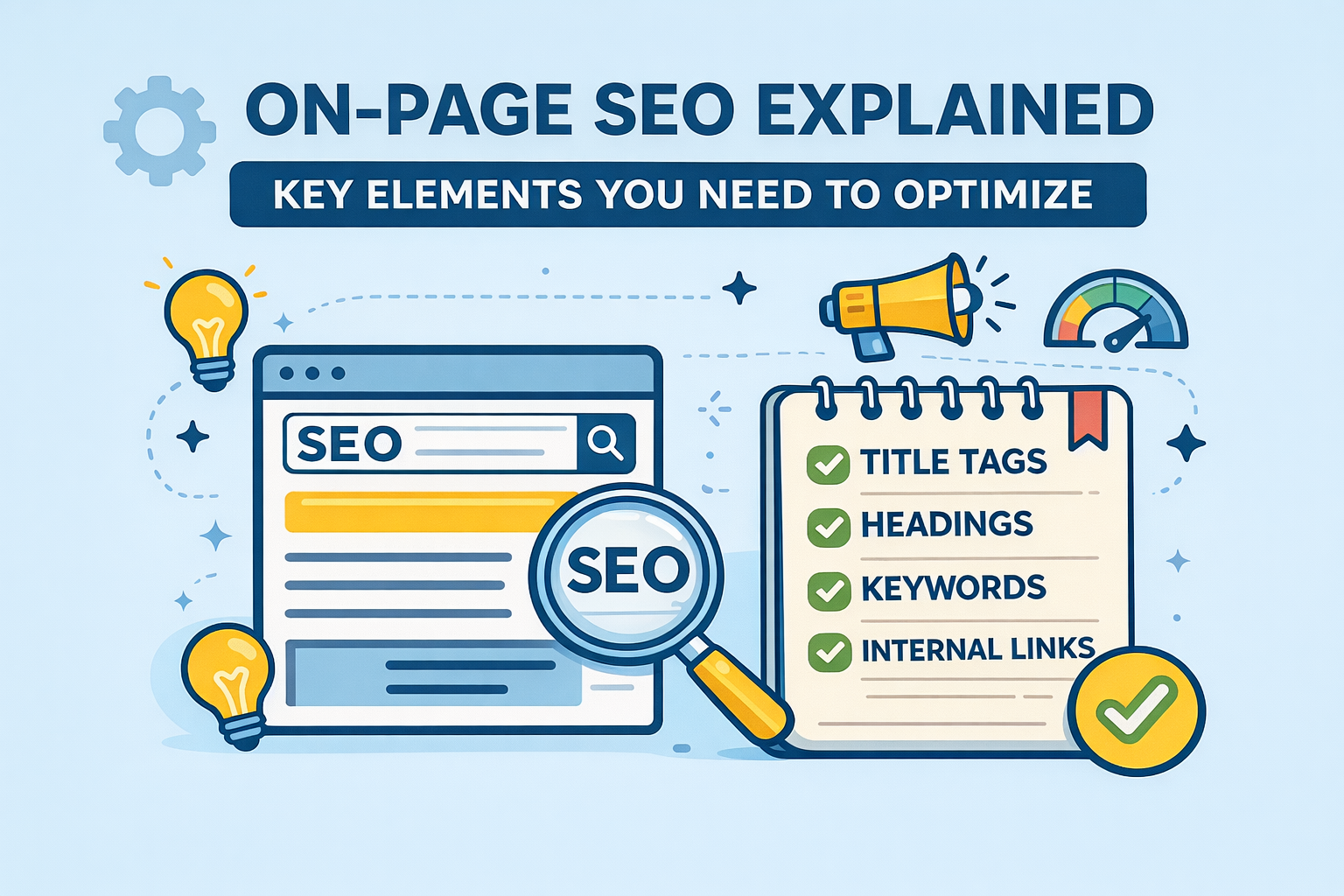
Getting your website to rank higher in search results doesn’t have to be complicated. On-page SEO is about optimizing the elements you control directly on your web pages to help search engines understand your content and give users a better experience.
We’ll walk through the most important on-page ranking factors, starting with title tag optimization and meta description best practices that can dramatically increase your click-through rates. You’ll also discover how to speed up your pages with image optimization and page speed optimization tactics, plus build a smart internal linking strategy that helps search engines crawl your site more effectively.
Master Title Tags for Higher Click-Through Rates
Craft Compelling Headlines That Drive Traffic
Your title tag acts as the first impression searchers get of your content. Think of it as your elevator pitch in search results – you have seconds to convince someone to click on your link instead of the nine others surrounding it. The most effective titles create curiosity while clearly communicating value.
Start by understanding your audience’s pain points. A title like “10 Ways to Save Money on Groceries” immediately tells readers what they’ll get. Compare this to a generic “Grocery Shopping Tips” – the difference in click potential is massive.
Optimize Title Length for Maximum Visibility
Search engines typically display 50-60 characters of your title tag before truncating. This character limit isn’t arbitrary – it’s based on pixel width, meaning wider letters like “W” and “M” take up more space than narrow ones like “i” and “l.”
Keep your most important information within the first 50 characters to get proper visibility across all devices and search interfaces. Mobile users see even less, making front-loading crucial information essential for mobile optimization.
Here’s how different title lengths perform:
| Title Length | Visibility | Best Use Case |
| 30-50 characters | Fully visible everywhere | Brand names, simple topics |
| 51-60 characters | Visible on most devices | Standard blog posts, products |
| 60+ characters | Often truncated | Acceptable if key info comes first |
Don’t sacrifice meaning for shortness. A 65-character title that perfectly describes your content beats a 50-character title that confuses readers. Just make sure your primary keyword and main benefit appear early.
Include Target Keywords Naturally
Strategic keyword placement in title tags remains a fundamental ranking factor in on-page SEO. Your title should read like something a human would actually say or search for. Place your primary keyword toward the beginning of your title when possible.
Secondary keywords can enhance relevance without feeling forced. If you’re targeting “SEO optimization techniques,” you might create a title like “SEO Optimization Techniques That Boost Rankings in 2026.” This naturally incorporates your keyword while remaining readable and compelling.
Synonyms and related terms help search engines understand your content’s context. Instead of repeating “title tag optimization” multiple times across your site, mix in variations like “title optimization,” “HTML title tags,” and “page title SEO.”
Avoid Keyword Stuffing and Duplicate Titles
Keyword stuffing in title tags creates terrible user experiences. Modern SEO rewards quality over quantity. Search engines can detect when you’re manipulating titles for ranking purposes rather than user benefit. They prefer titles that sound natural and provide genuine value to searchers. A clean title like “Best Pizza Restaurants in Delhi” outperforms keyword-stuffed alternatives.
Duplicate title tags across your website confuse search engines about which page to rank for specific queries. Each page needs a unique title that accurately reflects its specific content. Even similar pages should have distinct titles that highlight their unique angles or benefits.
Use title tag templates for consistency while maintaining uniqueness. For product pages, you might use “[Product Name] – [Key Benefit] | [Brand Name]” but ensure each product’s specific details make every title distinct. This systematic approach prevents accidental duplication while maintaining brand consistency across your site.
Write Meta Descriptions That Convert Visitors
Create Convincing Summaries Under 160 Characters
Meta descriptions appear below your title tag and give searchers a preview of what they’ll find on your page. The 160-character limit isn’t arbitrary – search engines typically truncate descriptions beyond this point, cutting off your message mid-sentence.
Crafting effective meta description best practices starts with understanding your audience’s pain points. When someone searches for “best running shoes for beginners,” they want specific information, not vague promises. Your description should directly address their query while highlighting your unique value proposition.
Include Primary Keywords and Call-to-Action
Smart keyword placement in meta descriptions signals relevance to both search engines and users. Your primary keyword should appear naturally within the first 120 characters, where it’s most likely to be bolded in search results. This visual emphasis draws attention and confirms you’re addressing the searcher’s query.
Call-to-action phrases transform passive readers into active visitors. Power words like “discover,” “learn,” “get,” and “find” create urgency and expectation. Action-oriented language works especially well:
- “Download your free checklist”
- “Get instant access to…”
- “Discover the secret to…”
- “Start your transformation today”
People search with intent, often driven by problems they need solved or goals they want to achieve. Your description should acknowledge their situation and promise a solution.
Make Each Description Unique and Relevant
Duplicate meta descriptions confuse search engines about which page to prioritize for specific queries. Every page on your site serves a different purpose and targets different search intent, so descriptions should reflect these distinctions.
Create a simple system for ensuring uniqueness:
Product Pages: Include specific product features, benefits, and pricing information
Blog Posts: Highlight key takeaways, tips, or insights readers will gain
Service Pages: Focus on outcomes, process, or what makes you different
Category Pages: Summarize the range of options and help visitors navigate
Different page types require different approaches. Your homepage description should capture your overall brand promise, while individual blog posts can be more specific about the exact problem you’re solving. A local business page might include location and service area, while an e-commerce category page could mention product variety and price ranges.
Test variations by monitoring click-through rates in Google Search Console. Pages with below-average performance often benefit from rewritten descriptions that better match search intent or include more compelling calls-to-action.
Structure Content With Strategic Header Tags
Use H1 Tags to Define Page Purpose
Your H1 tag acts as the main headline that tells both search engines and visitors what your page is all about.
Each page should have exactly one H1 tag that captures the essence of your content. This isn’t just an SEO optimization technique; it’s a fundamental way to establish hierarchy and context. Search engines use your H1 to understand your page’s main topic, making it a critical on-page ranking factor.
Your H1 should match the searcher’s intent behind your target keyword. If someone searches for “homemade pizza recipes,” your H1 might read “Easy Homemade Pizza Recipes for Beginners” rather than something vague like “Cooking at Home.” The more specific and relevant your H1, the better it serves both users and search engines.
Organize Content Flow with H2 and H3 Tags
H2 and H3 tags create the backbone of your content structure, breaking down complex topics into digestible sections. Your H2 tags should represent the main subtopics under your H1, while H3 tags dive deeper into specific aspects of each H2 section.
This hierarchical approach makes your content scannable and logical. Readers can quickly jump to the sections that interest them most, while search engines can better understand how your ideas connect and flow together.
Here’s how to structure your headers effectively:
- H2 tags: Major section breaks that cover distinct subtopics
- H3 tags: Specific points or examples within each H2 section
- H4 tags: Additional details or sub-points when needed
Avoid skipping header levels – don’t jump from H2 directly to H4. This breaks the logical flow and can confuse both readers and search engines about your content organization.
Include Keywords in Headers Naturally
Strategic keyword placement in headers helps search engines understand your content’s relevance without sacrificing readability. Your primary keyword should appear in your H1, while related keywords and variations can find their way into H2 and H3 tags.
| Header Level | Keyword Strategy | Example |
| H1 | Primary keyword | “Complete Guide to SEO Optimization Techniques” |
| H2 | Related keywords | “Title Tag Optimization Strategies” |
| H3 | Long-tail variations | “How to Write Compelling Title Tags” |
Remember that search engines have become sophisticated at understanding context and intent. They recognize synonyms, related terms, and semantic relationships, so you don’t need to use exact-match keywords into every header.
Improve Readability and User Experience
Well-structured headers transform dense blocks of text into easily navigable content. When readers land on your page, they should be able to read your headers and immediately understand what information you’re providing and where to find it.
Consider these readability best practices:
- Keep headers concise but descriptive
- Use action words when appropriate
- Make each header standalone – readers should understand the section’s focus without reading previous content
- Maintain consistent tone and style across all headers
Search engines reward pages that keep users engaged, and proper header structure directly contributes to better user experience metrics like time on page and scroll depth.
Optimize URLs for Search Engines and Users
Create Clean, Descriptive URL Structures
Your website’s URL structure serves as the first impression for both search engines and users. Clean, descriptive URLs tell visitors exactly what to expect before they even click on your link. When someone sees a URL like “yoursite.com/website-design-services,” they immediately understand the page content, which builds trust and increases click-through rates.
Search engines prioritize URLs that clearly communicate page content. Google’s algorithms use URL structure as a ranking factor because it helps determine page relevance for specific search queries. A well-structured URL acts like a roadmap, guiding both crawlers and users through your site’s hierarchy.
Avoid generic URLs like “yoursite.com/page1” or “yoursite.com/article123.” These meaningless strings provide no context and waste valuable SEO opportunities. Instead, create URLs that mirror your content hierarchy and include relevant keywords naturally.
Keep URLs Short and Keyword-Rich
Shorter URLs perform better across all metrics. They’re easier to remember, share, and rank higher in search results. Aim for URLs under 60 characters when possible, as longer URLs often get truncated in search results and social media shares.
Strategic keyword placement in URLs strengthens your on-page SEO efforts. Include your primary keyword near the beginning of the URL path, but avoid keyword stuffing. The URL should read naturally while incorporating relevant terms that match user search intent.
Consider these examples:
- Good: yoursite.com/title-tag-optimization
- Poor: yoursite.com/everything-you-need-to-know-about-title-tag-optimization-techniques-and-best-practices
The shorter version maintains clarity while including the essential keyword phrase that users might search for.
Use Hyphens to Separate Words
Hyphens act as word separators that search engines understand and process correctly. While underscores and spaces might seem like alternatives, they create technical issues that can hurt your SEO performance.
Google treats hyphens as space separators, making “seo-optimization-delhi” readable as three distinct words. Underscores, however, connect words together, so “seo_optimization_delhi” appears as one long term to search engines.
This small technical detail impacts how search engines interpret your URLs and match them to relevant queries. Consistent hyphen usage across your site creates a professional appearance and ensures optimal crawling and indexing.
Avoid Dynamic Parameters When Possible
Dynamic URLs containing parameters like “?id=123&category=ppc” create multiple technical problems for SEO optimization. These URLs are harder for users to understand, remember, and share. They also generate duplicate content issues when the same page appears under different parameter combinations.
Static URLs consistently outperform dynamic alternatives in search rankings. They load faster, create better user experiences, and allow for more precise keyword targeting. When dynamic parameters are necessary, implement URL rewriting to create clean, static-looking alternatives.
Enhance Images for Better Performance and Rankings
Choose Descriptive, Keyword-Rich File Names
Your image file names play a bigger role in SEO optimization techniques than most people realize. Instead of uploading images with generic names like “IMG_1234.jpg” or “photo5.png,” rename them with descriptive terms that tell search engines exactly what the image shows.
Start by describing what’s actually in the picture. If you’re showing a red convertible car, name it “red-convertible-car.jpg” rather than leaving it as whatever your camera or designer called it. Include relevant keywords when they naturally fit, but don’t stuff them unnaturally.
Keep these naming conventions in mind:
- Use hyphens instead of underscores or spaces
- Stick to lowercase letters
- Keep names concise but descriptive
- Include your target keyword when relevant
- Avoid special characters or numbers unless necessary
For example, if you’re writing about kitchen renovations, “modern-kitchen-renovation-before.jpg” works much better than “kitchen1.jpg.” The descriptive filename helps search engines understand your content context and can even appear in image search results.
Write Compelling Alt Text
Write alt text that genuinely describes what someone would see in the image. Imagine explaining the picture to someone over the phone – that’s the level of detail you want. Keep descriptions between 8-15 words when possible, and include relevant keywords naturally without forcing them.
Here’s what makes great alt text:
| Good Alt Text | Poor Alt Text |
| “Blue running shoes on wooden floor” | “Shoes” |
| “Graph showing 30% increase in website traffic” | “Chart” |
Focus on the essential details that matter for understanding your content.
Compress Images for Faster Loading Speed
Page speed optimization directly impacts your search rankings and user experience. Large image files are often the biggest culprit behind slow-loading pages, making image compression a critical SEO optimization technique.
Most images can be compressed by 60-80% without noticeable quality loss. This dramatic size reduction translates to faster loading times, better user experience, and improved search engine rankings.
Set up responsive images using different sizes for different screen sizes. A mobile user doesn’t need the same massive image that looks great on desktop screens.
Implement Internal Linking for Authority Distribution
Connect Related Content Strategically
Your internal linking strategy should create natural pathways between related content pieces. Think of your website as a roadmap where each link guides visitors to valuable, relevant information. When you write about “keyword research fundamentals,” link to your detailed guide on “long-tail keyword strategies” or “competitor keyword analysis.”
The key lies in contextual relevance. Search engines crawl these connections to understand your content relationships and topic expertise. Strategic internal links also keep visitors engaged longer, reducing bounce rates while increasing page views.
Your most popular blog posts and landing pages carry more link juice, so use them to boost underperforming pages. Create a content map to visualize these connections and identify linking opportunities you might have missed.
Use Descriptive Anchor Text
Generic anchor text like “click here” or “read more” wastes valuable SEO opportunities. Descriptive anchor text tells search engines exactly what the linked page covers while providing context for users.
Keep anchor text natural and varied. Using the exact same phrase repeatedly across multiple links can trigger spam filters.
The anchor text should accurately represent the destination page’s content. Misleading links frustrate users and hurt your credibility with search engines. When linking to your image optimization guide, use phrases like “image SEO best practices” or “optimize images for faster loading.”
Create Topic Clusters and Content Hubs
Topic clusters organize your content around central themes, establishing your expertise in specific areas. Start with a comprehensive pillar page covering broad topics like “complete SEO guide,” then create supporting content covering specific aspects like title tag optimization, meta descriptions, and page speed.
Link all cluster content back to the main pillar page and interconnect related subtopics. Users benefit from easy navigation between related concepts, spending more time exploring your expertise.
Build content hubs around your primary business topics. If you’re a digital marketing agency, create separate clusters for SEO, PPC, social media, and content marketing. Each hub becomes a comprehensive resource that attracts backlinks and establishes thought leadership.
Balance Link Distribution Across Pages
Avoid concentrating all internal links on just a few pages. Distribute linking power across your entire website to prevent creating “orphan pages” that receive no internal link support. Every published page should receive at least one internal link from another page on your site.
Monitor your link distribution using tools like Google Analytics or specialized SEO software. Pages with zero internal links often struggle to rank, regardless of content quality. Similarly, pages with excessive outbound links may dilute their linking power.
Create a linking schedule during content planning. When publishing new content, immediately identify three to five existing pages that could naturally link to it. This proactive approach ensures consistent link distribution while the content relationships remain fresh in your mind.
Regular content audits reveal linking imbalances and opportunities. Some high-performing pages might benefit from additional internal links, while others could share their authority by linking out to newer content that needs ranking support.
Boost Page Speed for Superior User Experience
Minimize HTTP Requests and File Sizes
Every time someone visits your webpage, their browser sends requests to your server for different files – images, stylesheets, scripts, and fonts. Each request takes time, and too many requests slow down your site significantly. Page speed optimization becomes critical when users expect pages to load in under three seconds.
Start by combining multiple CSS files into one and doing the same with JavaScript files. This simple change can cut your HTTP requests in half. Remove any plugins or widgets you don’t actually need – each one typically adds extra requests.
File compression makes a huge difference too. Use tools to shrink image files without losing visual quality.
Leverage Browser Caching and Compression
Browser caching stores copies of your website files on visitors’ devices, so return visitors don’t need to download everything again. Set up proper cache headers to tell browsers how long to keep different file types. Images and CSS files can be cached for months, while HTML pages might be cached for hours or days.
Configure your server to use GZIP compression for all text-based files. Most modern browsers support this compression method, which dramatically reduce download times. Set up cache-control headers for different file types: Content Delivery Networks (CDNs) amplify these benefits by serving cached files from servers closer to your visitors.
Conclusion
Getting your on-page SEO right comes down to mastering these seven essential elements. When you nail your title tags and meta descriptions, you’re setting the stage for higher click-through rates and more conversions. Pair that with well-structured headers, clean URLs, and optimized images, and you’ve got a solid foundation. Don’t forget about internal linking to spread authority around your site and keeping those page speeds lightning fast.
The best part about on-page SEO is that you have complete control over these elements. Start with the basics – fix your titles and descriptions first, then work your way through optimizing images and improving site speed. These aren’t just technical boxes to check off; they’re the building blocks that help real people find and engage with your content. Take it one step at a time, and you’ll see your search rankings and user experience improve together.